Imagine a syllabus written just for you. Not by a professor in a distant university, but by an intelligent agent that knows your skills, your blind spots, your goals, and even your ideal learning pace better than you do. For decades, the one-size-fits-all curriculum has been the bottleneck in online education—a rigid structure that often leads to boredom, frustration, and high dropout rates.
Are you tired of slogging through course sections you already know, or conversely, feeling overwhelmed by foundational concepts that were skipped? The traditional self-paced learning strategies often fail because they still rely on a static structure. The problem isn’t the content; it’s the lack of a responsive, dynamic path.
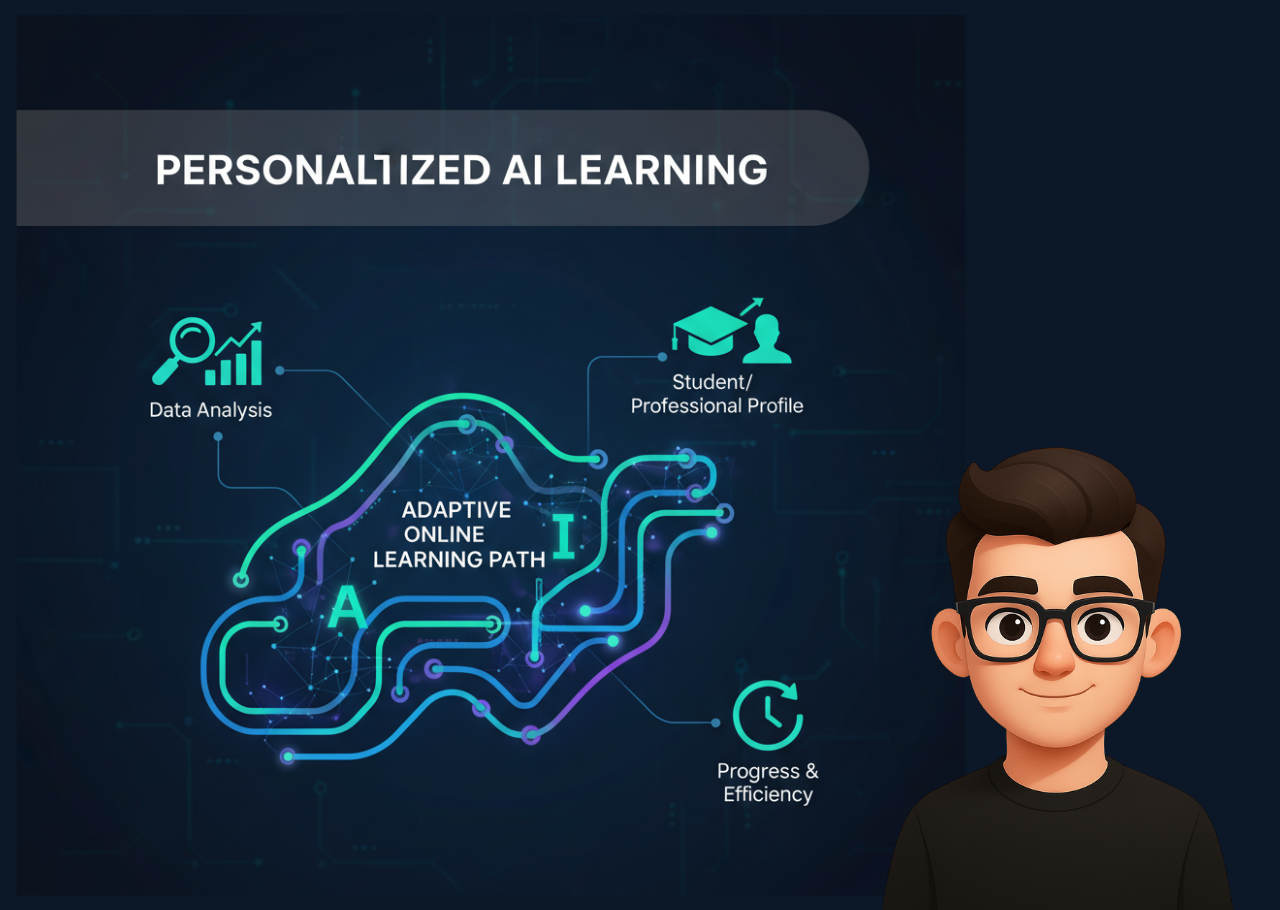
This guide is your blueprint for moving from passive course consumption to active curriculum co-creation using Artificial Intelligence. We will break down the exact, four-stage framework—Analyze, Architect, Adapt, Accelerate—to build your own adaptive online learning path that shifts and evolves as you do. Drawing on insights from data science and our experience with AI customized syllabus tools, we’ll show you how to leverage generative AI not just as a tutor, but as your personal Chief Learning Officer.
The Learning Bottleneck: Why the Static Syllabus Fails
The core challenge of online learning is relevance. Every learner, whether a student starting out or a professional upskilling, brings a unique set of prior knowledge. The rigid online course ignores this reality.
The Cost of Irrelevance
When you encounter content that is either too easy or too advanced, your cognitive load suffers. Spending hours on basic database concepts when you already work as a junior analyst is a waste of time and mental energy.
Conversely, skipping core statistical principles in a data science course can lead to shallow understanding later on. This static, linear progression is the primary reason for low completion rates in massive open online courses (MOOCs).
The Retention Drain
Generic course sequences ignore cognitive science principles like spaced repetition and personalized challenge levels. They treat every learner’s memory like a blank slate.
When a course doesn’t dynamically reinforce concepts you struggled with or move past concepts you mastered, retention drops significantly. AI’s true power lies in optimizing the learning material to fight this knowledge decay, making your personalized e-learning plan truly effective.
The 4A Framework: Creating Your AI Customized Syllabus
Building an effective adaptive online learning path requires a structured, intentional approach. We’ve distilled the process used by top ed-tech platforms into four actionable stages you can implement yourself.
Phase 1: Analyze – Diagnosing Your Learning Profile
Before you build, you must assess. AI is only as smart as the data you feed it. This phase focuses on collecting high-quality personal data to inform the syllabus design.
The Skill-Gap Audit
Start by defining the exact destination. Use AI tools to compare your current skill set against the requirements of your target role.
Try This: Take a target job description and use an advanced LLM (like a niche AI assistant) with a prompt like: “Analyze this Data Scientist job description. Based on my current skills (Python basic, Excel advanced, no cloud), generate a list of 10 prioritized skill gaps with a difficulty rating (1-10).”
This instantly gives you data-driven objectives. You can explore a powerful selection of tools for this in our guide: Beyond ChatGPT: 7 Niche AI Assistants for Digital Productivity in 2025.
The Cognitive Style Map
Identify how and when you learn best.
Format Preference: Do you absorb complex topics best through video, text, or interactive simulations?
Time: Are you a “morning learning” person or an “evening problem-solver”?
Focus Span: Do you require micro-learning modules (under 10 minutes) or can you handle deep 60-minute sessions?
Quick Try-It Guide: The “15-Minute AI Skill Gap Check”
Input: Paste your resume and your target job description into your preferred LLM.
Prompt: “Act as a hiring manager. Compare my resume to the JD. Provide a weighted list of the 5 most critical, unaddressed skill gaps. For each gap, suggest 3 introductory topics to test my current knowledge.”
Result: You get instant, personalized diagnostic questions that become the initial knowledge check for your AI customized syllabus.
Phase 2: Architect – Building the Personalized E-Learning Plan
Now, use the analysis results to assemble the learning path’s building blocks.
From Topics to Modules
Break down the vast subject into granular, measurable, and sequence-able units. For a “Data Science” topic, you don’t need a single video on ‘Modeling’; you need 15 micro-modules on Linear Regression Assumptions, Model Evaluation Metrics, and Regularization Techniques.
Pro Tip: The “10/90 Rule”
As you select resources, apply the “10/90 Rule”:
10% Essential Content: Non-skippable foundational theory and key concepts (e.g., the Law of Large Numbers).
90% Adaptive Content: Optional deep dives, remedial loops, varied examples, and bonus projects. The AI will primarily shuffle this 90% based on your performance.
Real Example: Case Study: The Professional’s Python Path
A mid-career professional came to EightBid.in needing to move from basic Excel to advanced Python automation. Their traditional MOOC started with basic variables, which they already knew.
Using the Architect phase, they manually skipped 30% of the foundational Python course structure and instead focused intensely on the libraries needed for their job: Pandas, NumPy, and Scikit-learn. Their adaptive online learning path was redesigned to loop back only if a concept in the advanced modules required a foundational review. They completed their learning objective in 4 months instead of the typical 6–9 months.
(To start building this skill, check out: Learn Python for AI and Automation)
Phase 3: Adapt – AI as Your Real-Time Learning Coach
This is where the ‘adaptive’ magic truly happens. Your syllabus shifts in response to your mastery and difficulty level, just like an intelligent tutoring system.
Adaptive Sequencing in Action
When you score 90%+ on a module quiz, a true adaptive system should instantly unlock the next three intermediate modules and skip the corresponding remedial section. Conversely, if you fail, the system should direct you to a mandatory, different-format resource (e.g., a video explanation instead of a text-based one).
Dynamic Assessment vs. Fixed Tests
AI moves beyond the fixed, periodic assessment. It uses dynamic assessment, modifying the difficulty and type of question depending on a learner’s immediate response. This ensures you’re always operating in the “Zone of Proximal Development”—challenged, but not overwhelmed.
AI Insight: Predictive Dropout Models Professional adaptive learning systems leverage Machine Learning (ML) to track factors like reduced logins, increased time-per-question, and declining quiz scores. This is used to flag students ‘at risk’ of disengagement. As an individual learner, you can use this insight to proactively build self-paced learning strategies that include a ‘human check-in’ or a required study break when your personal metrics start to drop.
Phase 4: Accelerate – Optimizing for Mastery and Retention
The final phase uses AI’s power to cement learning for the long term.
Spaced Repetition Integration
Retention is the ultimate goal. AI excels at calculating the optimal moment to review a piece of content before you forget it—a concept known as spaced repetition.
You can mimic this by integrating AI flashcard apps or simple automation tools that resurface your previously mastered content notes at increasingly longer intervals (e.g., Day 1, Day 3, Day 7, Day 30). This ensures efficiency and boosts long-term recall.
Automation of Feedback
For complex skills like coding or data analysis, immediate feedback is critical. You can use AI to automate the preliminary review of open-ended tasks.
Example: Use an AI code assistant to instantly identify bugs or stylistic improvements in a small code snippet, providing personalized guidance before a human instructor sees it. This drastically accelerates the practice-feedback loop. This is one of the quickest ways to be productive. Read more on automating notes here: The 5-Minute Productivity Hack: How to Automate Your Study Notes with AI.
Future of Online Education 2025
The next frontier of the future of online education 2025 is the integration of Augmented Reality (AR) and Virtual Reality (VR) into these paths. Imagine an adaptive online learning path for an engineer that uses VR to simulate a broken machine when they fail a theory assessment, providing a hands-on, adaptive challenge.
E.E.A.T. and Ethics: Trusting Your Algorithmic Teacher
Trustworthiness in an AI customized syllabus is paramount. We must acknowledge the ethical implications of handing over our learning path to an algorithm.
Data Privacy and Transparency
To earn your trust, the tools you use must be transparent about what data is collected (your quiz scores, time-on-task, and resource preferences) and how it is used to generate the next recommendation. Always favor platforms that prioritize user data control.
Avoiding the “Filter Bubble”
A significant risk with highly personalized content is the filter bubble—the AI only suggests what it thinks you like or what falls within your current knowledge base, neglecting diverse viewpoints or complex, but necessary, tangents.
Pro Tip: Incorporate human-curated resources (expert reading lists, renowned academic papers) and non-AI-suggested topics into your plan. This prevents tunnel vision and builds true Authority in your field.
You don’t need a multi-million-dollar LMS to start.
AI-Powered Learning Platforms: Platforms like Coursera and edX increasingly use AI features to suggest the next best course based on your completion data. Specialized tools like Knewton are built entirely on adaptive principles, especially effective for foundational subjects.
DIY Syllabus Generators (LLMs): Use advanced LLM prompts to generate a structured, foundational syllabus from scratch, which you then manually refine using the 4A Framework’s data.
Conclusion
We’ve outlined the essential shift from a rigid, one-size-fits-all education to a dynamic, self-co-created adaptive online learning path. By adopting the 4A Framework (Analyze, Architect, Adapt, Accelerate), you move from a passive student to an active curriculum designer, using AI as your engine for personalization. This is the future of online education 2025—a journey defined by your unique potential, not a pre-set curriculum.
The time for a passive learning journey is over. Start actively designing your future today.
Want to explore more AI tools and automation tutorials? Visit EightBid.in for hands-on learning and resources.
❓ Frequently Asked Questions (FAQs)
1. What is the main difference between self-paced and adaptive learning?
Self-paced learning lets you control the time spent on static content. Adaptive learning uses AI to control the content, sequence, and difficulty in real-time based on your performance, essentially creating a moving syllabus.
2. Which AI tools can help me build a personalized e-learning plan today?
Generative AI models (like advanced LLMs) can create a structured syllabus based on a target job/skill. Specialized tools like Knewton, ALEKS, or RealizeIt offer fully-adaptive content delivery, especially in STEM fields.
3. Is AI-customized syllabus creation ethical?
Yes, provided the system is transparent about data usage and avoids algorithmic bias. Learners should maintain agency to override AI recommendations and seek diverse, human-vetted resources to ensure a comprehensive education.
4. Will adaptive learning replace human instructors by 2025?
No. AI enhances the learning experience by automating personalization and grading, freeing human instructors to focus on high-value activities like mentorship, complex problem-solving, and cultural context—where AI falls short.