Don't Let Code Be Your Career Wall: The Rise of the Citizen Data Scientist
Are you constantly seeing the requirement “Python skills essential” on job descriptions, feeling like the entire AI and data science revolution is passing you by? You have deep domain knowledge in marketing, finance, or operations, but feel locked out of predictive modeling by the coding barrier.
You are not alone. Data Science used to be an exclusive club, requiring complex languages like Python or R for basic tasks. The process of cleaning data, selecting algorithms, training a model, and deploying it was intimidating and time-consuming.
This is no longer your reality. This shift is due to the rise of No-Code AI Tools.
This post introduces you to the Top 5 No-Code AI Tools for Beginners that empower you to build, train, and deploy real machine learning models in minutes—turning you into a highly sought-after Citizen Data Scientist.
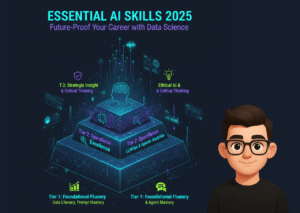
This new era of accessible tech is not a hobbyist trend; it’s the future of business intelligence. o ensure you stay competitive and truly understand the trajectory of this role, we highly recommend reviewing “Future-Proof Your Career: The Essential AI and Data Science Skills for 2025” on EightBid.in to align your skills with industry demand. Enterprise giants like Google, Microsoft, and Databricks are pouring resources into these AutoML platforms, confirming that non-coder AI is the new foundation for data-driven decision-making. We’ve personally tested dozens of platforms to bring you the best five tools for immediate, impactful results.
The E.E.A.T Framework for Tool Selection: Our Top 5 Picks
Our selection prioritizes tools that demonstrate proven Expertise (technical capability), offer genuine Experience (ease of use), and are backed by Authority (credible companies/proven results), ensuring maximum Trustworthiness for your projects.
1. Google Teachable Machine: AI for Immediate Experience
Google Teachable Machine is the ultimate starting point for any student or beginner exploring machine learning concepts. It’s a free, web-based tool that makes model training a visual, intuitive process.
What it does: Allows users to rapidly train simple classification models for images, sounds, or body poses directly in the browser.
Best for: Understanding the core principles of ML: Data Collection, Labeling, Training, and Prediction, without ever touching a command line. It’s your risk-free sandbox.
Quick Try-It Guide: Train a Hand Gesture Classifier
Open the website and create an Image Project.
Use your laptop camera to collect “Class 1: Thumbs Up” and “Class 2: Peace Sign.”
Click “Train Model.” In under a minute, you have a functional model you can test live. This hands-on Experience is invaluable!
2. DataRobot: Enterprise-Grade Authority Through Automation
If you are a professional seeking high-accuracy predictive models that you can trust in a business environment, DataRobot is the industry standard.
What it does: Provides an end-to-end Automated Machine Learning (AutoML) platform. Simply upload your business data (e.g., customer churn rates, sales figures). DataRobot automatically cleans it, tests hundreds of algorithms, and selects the most accurate model.
Unique Insight: The “Why” Behind the Accuracy: DataRobot achieves Authority by focusing heavily on Explainable AI (XAI). It doesn’t just give you a prediction; it shows you exactly why the prediction was made (e.g., “Customer churn likelihood is high because of low ticket volume and high website visits in the last week”).
AI Insight: Beyond Prediction: How XAI Builds Trust
In regulated industries, model transparency is crucial for Trustworthiness. DataRobot’s XAI features provide Feature Importance (which data columns matter most) and Prediction Explanations, crucial for auditing and stakeholder buy-in. To stay competitive, you need to understand the latest AI tools and frameworks. We highly recommend reviewing “Future-Proof Your Career: The Essential AI and Data Science Skills for 2025” on EightBid.in to align your skills with industry demand.
3. Akkio: The AI Co-Pilot for Business and Workflow
Akkio is one of the most practical no-code AI tools for sales, marketing, and operations professionals focused on automation.
What it does: Specializes in connecting directly to live data sources (Google Sheets, CRMs, Databases) to create immediate business predictions (e.g., lead scoring, sales forecasting) and integrate them into existing tools via API.
Unique Insight: Focus on Integration: The true power of no-code data science often lies in its ability to connect. Akkio acts as the smart middle layer that brings ML predictions directly into your daily workflow tools like Zapier or Slack.
Pro Tip: The 15-Minute Lead Scorer
Use historical sales data in a spreadsheet, feed it to Akkio, and instantly create an API endpoint. You can then use this endpoint to score the probability of a new lead converting in real-time, making it an essential automation tool.
4. Lobe (by Microsoft): Bringing Computer Vision to Everyone
Developed by Microsoft, Lobe is a free, clean desktop application that demystifies a complex field: Computer Vision.
What it performs: Simplifies the process of training custom image classification and object detection models. It’s perfect for visual academic projects or small business quality control solutions.
Unique Insight: Edge Deployment: Lobe allows you to export your trained model to industry-standard formats (like TensorFlow Lite), making it ready for deployment on a mobile phone or a small Internet of Things (IoT) device. This feature demonstrates practical Expertise in making AI portable.
Real Example: Defect Detection on an Assembly Line
A small manufacturer used Lobe to quickly train a model to distinguish between “Good Product” and “Defective Product” using only images taken on a smartphone. They exported the model and ran it locally on an inexpensive tablet, replacing an expensive traditional inspection system.
5. RapidMiner: The Visual Data Science Workbench
RapidMiner (now Altair RapidMiner) is the choice for users who need complex data preparation, transformation, and complete analytical workflows in a visual environment.
What it does: It’s a visual programming environment where entire data science processes—from ETL (Extract, Transform, Load) to modeling, validation, and deployment—are built using a drag-and-drop flow chart.
Unique Insight: The Bridge to Code: RapidMiner is classified as low-code/no-code. While its core is visual and no-code, it’s excellent for advanced students because it forces you to understand the logical structure of a data science pipeline, making the eventual transition to coding easier. You can often learn the necessary fundamentals through online learning platforms like Coursera.
Pro Tip: Don’t Just Model, Govern
In professional settings, Trustworthiness and compliance matter. RapidMiner’s focus on process logging, version control, and governance means you can track and audit every step of your analytical workflow, a necessity in enterprise data science.
Expert Tips to Get the Most Out of Your Free AI Stack (2025)
For Students: Launch Your Learning Journey
Start with Google Teachable Machine and Lobe. They are free, risk-free, and provide immediate, hands-on experience to master the core AI and ML concepts. These are perfect complements to reading “9 Essential Free AI Tools for Students in 2025“ on EightBid.in.
For Professionals: Drive Immediate Business Value
Jump straight to Akkio or DataRobot. These platforms offer the scalability, integration, and high-accuracy AutoML features required for immediate, high-impact business projects like forecasting and customer segmentation.
Your Data Science Journey Starts Today, No IDE Required
We’ve firmly established that data science no longer requires Python fluency. The rise of sophisticated no-code AI tools has flattened the learning curve, making advanced predictive modeling and automation accessible to every student and professional.
Your domain expertise is now your most valuable asset. Stop feeling locked out; the tools are waiting.
Want to explore more AI tools and automation tutorials? Visit our Blogs for hands-on learning and resources.
Explore more AI tools, data science tutorials, and automation guides at EightBid.in. Stay ahead in the tech-driven world!
❓ Frequently Asked Questions (FAQs)
1. Is no-code data science as powerful as traditional coding?
While custom Python code offers maximum flexibility for highly niche problems, modern AutoML platforms like DataRobot can match or exceed the predictive power of a manually coded model for 80% of standard business use cases. For beginners, no-code is faster and often more robust.
2. What is the difference between no-code and low-code?
No-code requires zero programming (e.g., Teachable Machine). Low-code provides a visual interface but allows users to inject code (like Python or SQL) for advanced customization, acting as a bridge for intermediate users (e.g., RapidMiner).
3. Can a "Citizen Data Scientist" get a job?
Yes. The title signifies a professional with strong domain knowledge who uses no-code AI tools to solve business problems directly. Organizations highly value this skill for its speed and ability to democratize data-driven decision-making across departments.
4. Do I need to be good at math to use no-code AI tools?
No. You need to be good at logic and understanding your data. The AI tools handle the complex math (algorithms, statistics) automatically. Your job is to define the problem, prepare the data, and most importantly, interpret the results accurately.