Do you feel overwhelmed by the constant stream of digital tasks—the endless research, the mandatory meetings, the messy notes, and the looming deadline for that long-form content? ChatGPT solved the start of the problem, but in 2025, being productive means being precise. When you need a scalpel, a Swiss Army knife just won’t cut it.
While tools like ChatGPT and Gemini are revolutionary generalists, they lack the deep, context-aware specialization needed to truly master high-value professional workflows. Relying on a single chatbot for everything from writing an article to summarizing a complex data science paper is often inefficient, resulting in generic outputs.
The key to unlocking digital workflow automation is shifting from a general AI assistant to a fleet of niche AI assistants productivity tools.
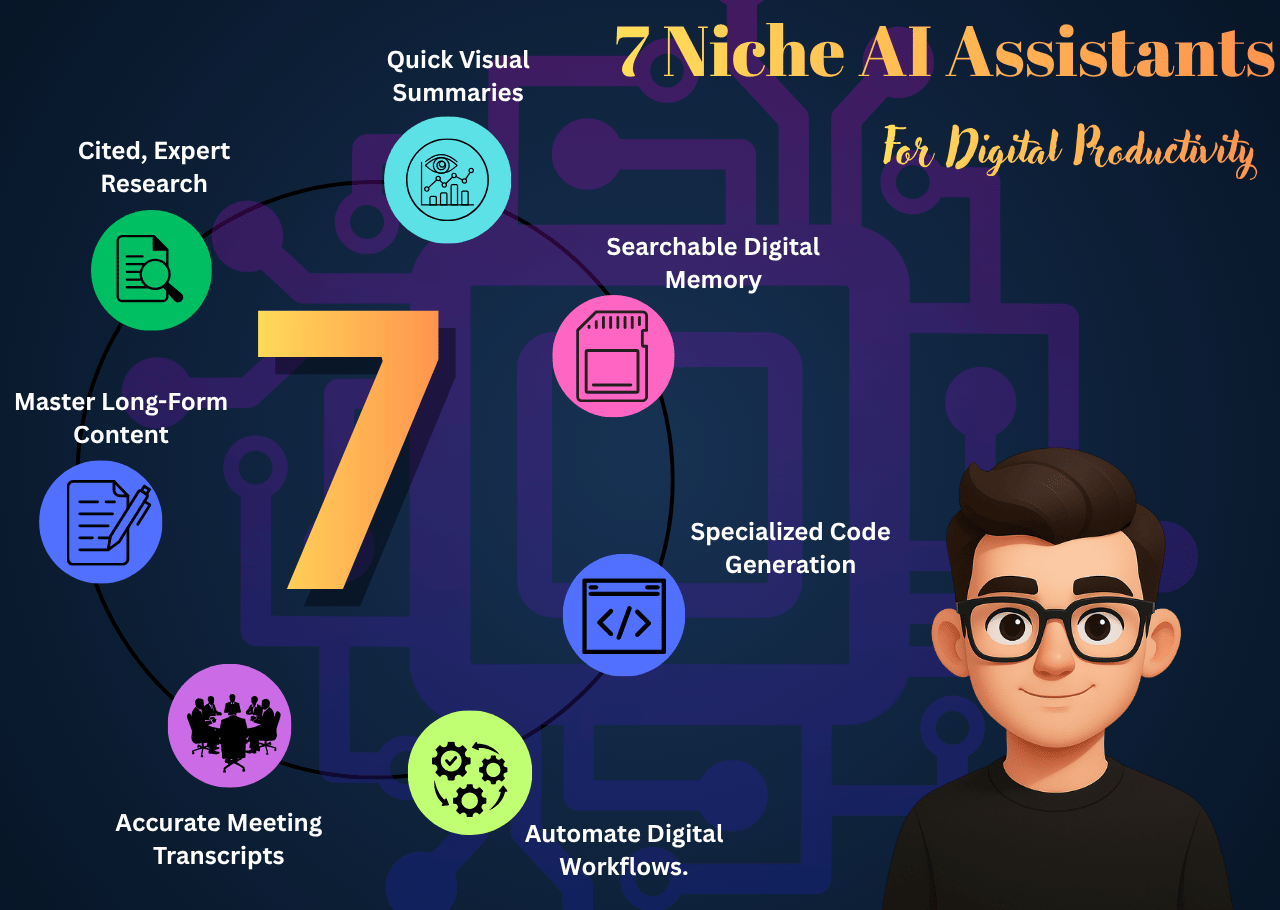
This article moves beyond ChatGPT to reveal 7 cutting-edge, specialized generative AI tools—each designed to dominate a single, complex area of your professional or student life. We’ve tested these tools to bring you an E.E.A.T-compliant guide on how to integrate true AI specialization into your 2025 workflow.
If you are a student ready to dive into the technical backbone of these tools, start to learn Python for AI and Automation today.
E.E.A.T Reflection: According to a 2024 study by BCG and Harvard, workers who augmented their tasks with specialized generative AI saw a 25% increase in speed and a 40% increase in quality on specific, complex tasks. We apply that same standard of rigor in selecting the tools you need.
The 7 Niche Pillars of AI Productivity
Pillar 1: Deep, Cited Research & E.E.A.T Sourcing (The Knowledge Worker’s Edge)
Research is the foundation of authority. Your output is only as strong as your sources. This is where tools prioritizing citation and scholarly integrity shine, moving far beyond basic web summaries.
The Researcher: Perplexity AI / Elicit (Cited and Scholarly Search)
Value Proposition: These tools go beyond simple search engines. They prioritize source citation and scholarly rigor, essential for students writing theses and professionals building thought leadership content. Elicit, in particular, focuses on scanning academic papers.
Pro Tip: Use Perplexity’s “Focus” feature (e.g., “Academic,” “Reddit,” or “YouTube”) to narrow down your source data before tackling a new project.
Real Example (E.E.A.T Integration): A researcher at a fintech firm used Elicit to summarize 50 papers on “predictive modeling in finance” in under 10 minutes. The output included direct source links for every claim, instantly generating a credible, foundational literature review. This is how you build authority fast.
Pillar 2: Mastering Long-Form Content & Brand Voice
Creating high-volume, high-quality content that maintains a consistent voice is where general LLMs struggle. The best long-form AI assistants are not just about speed; they’re about quality control.
The Ghostwriter: Writer.com / Jasper AI (Best AI for Writing Long-Form Content)
Value Proposition: Unlike generalist chatbots, these tools are trained on large, proprietary datasets designed to maintain a consistent brand voice, integrate complex SEO briefs, and handle drafts exceeding 5,000 words—the true benchmark for high-value authority content.
AI Insight: Why context windows and proprietary training (not just GPT-4 access) are crucial for generating high-quality long-form content. A large context window helps the AI remember the tone and argument you established at the start of a 10,000-word piece, preventing it from losing coherence midway.
Pillar 3: Meeting and Lecture Automation (Focusing on Accuracy)
Time spent manually taking notes is time lost for strategic thinking or active learning. The right assistant for this niche must prioritize accuracy and intelligent summarization.
The Scribe: Fireflies AI / Otter AI (AI for Meeting Transcripts Comparison)
Value Proposition: These tools eliminate note-taking during classes, client calls, or team stand-ups. Specialized AI for audio transcription achieves near-perfect accuracy and instantly generates action items, summaries, and thematic clusters. This niche focus makes them the gold standard for AI for meeting transcripts comparison.
Quick Try-It Guide:
Connect Otter AI to your calendar.
It joins your meeting (Zoom, Meet, Teams) automatically.
After the call, you receive a full, searchable transcript with a 3-point summary and an action-item list.
Don’t miss our guide on The 5-Minute Productivity Hack: How to Automate Your Study Notes with AI for a deep dive into transcription for academic success.
Pillar 4: Digital Workflow Automation & Integration
This is the frontier of productivity: getting your apps to talk to each other without you lifting a finger. This level of specialization defines true digital workflow automation.
The Integrator: Zapier Agents / Bardeen AI (Digital Workflow Automation)
Value Proposition: These autonomous agents move data between thousands of apps. You set a complex goal—like “Monitor competitors’ pricing and update the team Slack channel”—and the agent handles the multi-step, cross-platform task hands-free.
Pro Tip: Use a Zapier Agent to connect your online learning platform’s completion certificates (Coursera, edX) to a LinkedIn update draft or a project management tool, automating your professional development documentation. This instantly demonstrates experience and expertise.This proactive approach is a core principle of creating an adaptive online learning path that tracks your growth and maximizes skill acquisition efficiency.
Pillar 5: Specialized Code Generation & Debugging
For data science students and developers, coding is a high-stakes, specialized task. Generic coding help is prone to errors; niche tools are trained on vast repositories of high-quality, peer-reviewed code.
The Coder: GitHub Copilot (AI for Data Science and Engineering)
Value Proposition: An AI tool specifically integrated into development environments (IDEs) to suggest, complete, and explain complex code blocks in languages like Python and SQL. This is indispensable for data science students and software professionals.
Real Example: Imagine a student struggling to write a complex Python function for cleaning a messy dataset. Copilot instantly suggests the correct function with well-commented code, saving hours of manual debugging. This accelerates online learning dramatically.
For more on the technical side, check out the Google AI Blog which often discusses the LLM advancements powering these coding assistants.
Pillar 6: Digital Memory & Second Brain Management
How many times have you forgotten where you saw a critical piece of information? This niche focuses on creating a contextual, searchable record of your digital life.
The Archivist: Rewind AI / Quivr (Your Contextual Second Brain)
Value Proposition: These tools record and index everything you see, hear, and say on your computer (with strong privacy controls), making your entire digital life searchable using natural language prompts. Never lose a source, a detail, or a meeting note again.
Pro Tip: Ask Rewind questions like, “Where did I see that key statistic about Python adoption rates for data science last week?” and watch it replay the exact moment. This instant recall of experience boosts your trustworthiness and speed.
Pillar 7: Visual & Structured Summarization
Data and reports only matter if they can be quickly consumed. The niche here is high-speed, high-quality visual communication.
The Presenter: Gamma App (AI for Quick Visual Reports and Decks)
Value Proposition: Quickly turn outlines, long documents, or data summaries into polished, visual presentations and web pages. It bypasses the manual formatting work of PowerPoint/Google Slides, maximizing time efficiency for report delivery and allowing you to focus on the core insights.
Quick Try-It Guide: Turn the summary of your long-form content into a shareable Gamma presentation in three steps: Paste Text -> Choose Theme -> Export. Simple, powerful.
Conclusion
The Era of Precision Productivity Has Arrived
The shift in 2025 is not about finding a single AI to do everything, but about building an ecosystem of niche AI assistants productivity tools that perfectly match your highest-value tasks. By moving beyond ChatGPT and integrating specialized tools for research, long-form writing, and digital workflow automation, you transition from being simply augmented by AI to becoming an AI-powered professional.
This precision approach—leveraging the right specialized generative AI tools for the right job—is the only way for both students and professionals to truly maximize their time, boost the quality of their work, and demonstrate genuine expertise.
Want to explore more AI tools and automation tutorials? Visit EightBid.in for hands-on learning and resources.
❓ Frequently Asked Questions (FAQs)
1. What is the difference between a general AI like ChatGPT and a niche AI assistant?
A general AI is trained on broad data to perform many tasks adequately. A niche AI is highly specialized, trained on specific, curated datasets (like legal documents, code, or scholarly papers) to perform one high-value task with superior accuracy, such as creating accurate AI for meeting transcripts comparison or precise digital workflow automation.
2. Which AI is best for writing long-form content?Which AI tools can help me build a personalized e-learning plan today?
While ChatGPT can draft outlines, dedicated long-form assistants like Writer.com or Jasper are superior because they are optimized for brand voice consistency, SEO keyword integration, and managing the coherence of very long articles, making them the best AI for writing long-form content.
If budget is a concern, many of these niche platforms offer generous free tiers. We compiled a list of 9 Essential Free AI Tools for Students in 2025 to get you started without cost.
3. Are specialized generative AI tools expensive?
Many specialized generative AI tools offer freemium tiers for individual use (e.g., Perplexity AI, Otter AI). Pricing typically scales based on the intensity of usage, such as the number of transcription minutes or the volume of words generated.
4. How can I ensure the data from my niche AI assistants is trustworthy?
Always use tools that provide source citations (like Elicit or Perplexity AI) and utilize a hybrid human-AI workflow. The human expert must verify factual claims and integrate their unique perspective, ensuring E.E.A.T compliance.