Why This Matters to You
Imagine a school where your child doesn’t just learn about computers but learns with Artificial Intelligence (AI) from day one. That is the future the Government of India is building. In the Union Budget 2026, Finance Minister Nirmala Sitharaman announced a major shift: we are moving beyond just talking about AI in labs to bringing it into our daily education and jobs.
A new high-powered body, the “Education to Employment and Enterprise” Standing Committee, has been proposed. Its goal? To make sure that by the time a student leaves college, they are not just “degree-ready” but “job-ready” for an AI-first world.
The Big Shift: From Labs to Classrooms
For years, the focus was on setting up isolated “Centres of Excellence” (CoEs) for top-tier research. While those are still important, the 2026 mandates a change. The government realizes that AI cannot sit in a glass tower; it must be part of the school bag.
1. AI in School Curriculum
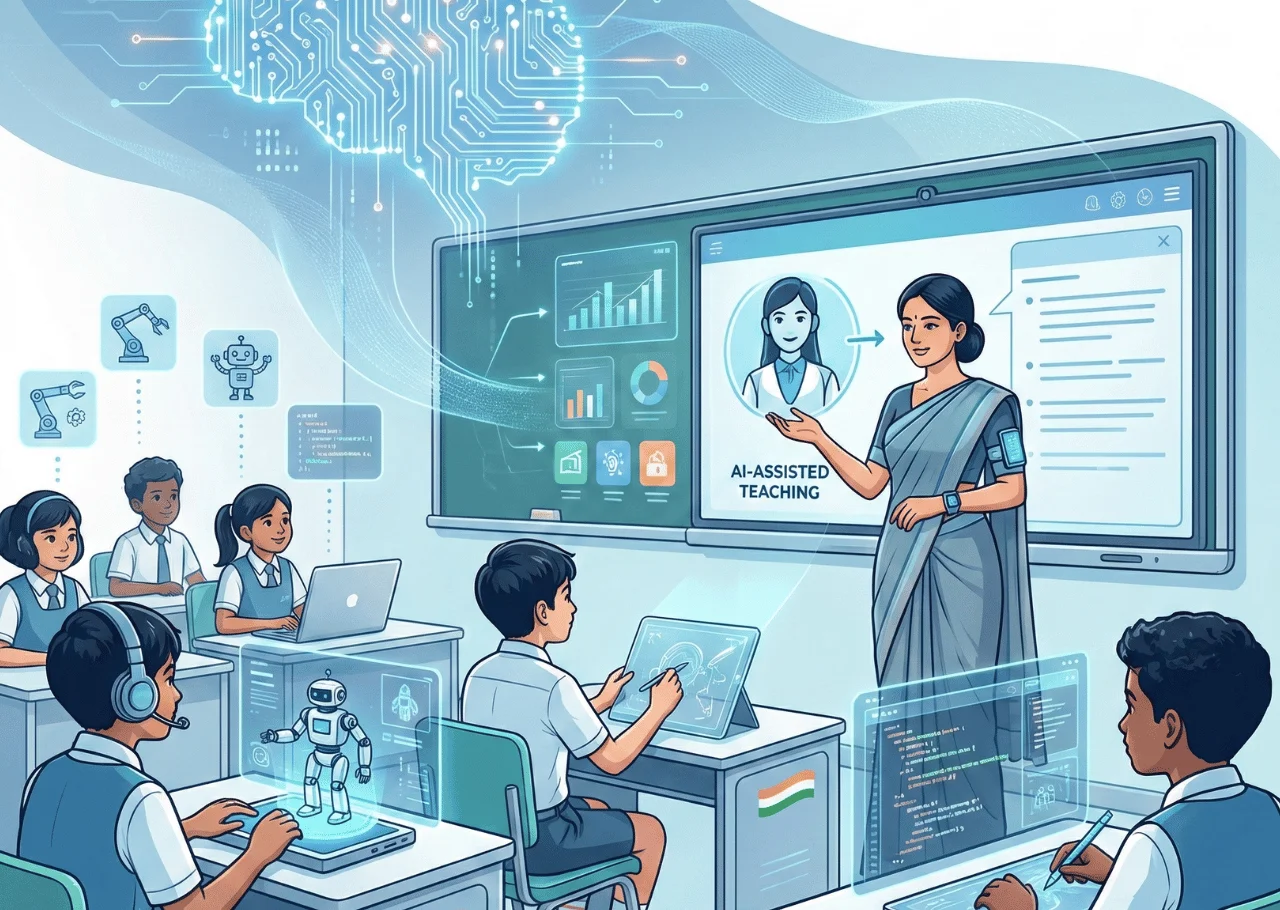
The committee has a clear mandate: Embed AI into school curricula. This doesn’t mean just adding a coding class. It means integrating AI concepts into how subjects are taught, ensuring students understand how to work alongside smart machines early on.
2. Upgrading Our Teachers (SCERTs)
You cannot teach the future with tools from the past. A massive part of this initiative is upgrading State Councils of Educational Research and Training (SCERTs). Teachers across India—from metro cities to rural districts—will be trained to use AI as a teaching aid. This empowers the “Guru” to guide the “Shishya” effectively in the digital age.
3. The 10% Global Goal
The committee isn’t just about education; it’s about the economy. The target is ambitious: Make India a global leader in the services sector with a 10% global market share by 2047 (Viksit Bharat). To do this, our workforce needs skills that the rest of the world is scrambling to find.
Key Facts & Data
Announcement Date: February 1, 2026 (Union Budget 2026-27).
Primary Body: “Education to Employment and Enterprise” Standing Committee.
Budget Allocation: Part of the ₹1.39 lakh crore Education Budget.
Related Initiative: Bharat-VISTAAR, a multilingual AI tool launched to help farmers, showing AI’s reach beyond just IT jobs.
Creative Economy Push: 15,000 schools and 500 colleges will get “Content Creator Labs” for the AVGC (Animation, Visual Effects, Gaming, and Comics) sector.
Impact on India
For Students & Parents
No Rote Learning: The focus shifts from memorizing facts to critical thinking and using AI tools.
New Career Paths: Students will be prepared for jobs that don’t even exist yet, especially in the “Orange Economy” (creative arts + tech).
For Businesses & Startups
Ready Talent: Companies often complain that fresh graduates need months of training. This policy aims to fix that “employability gap.”
EdTech Boom: Startups in the education sector will see huge opportunities to partner with schools for AI tools and training modules.
For Teachers
Upskilling: Teachers will receive support, not replacement. The government plans to use AI to reduce their administrative burden so they can focus on teaching.
Future Outlook: The Road to 2047
This committee is a stepping stone toward “Viksit Bharat 2047” (Developed India 2047). The immediate next steps likely include a nationwide “AI readiness” audit of schools and the rollout of pilot programs in government schools. If successful, India could become the world’s “talent factory” for the AI era, much like it became the back office of the world in the 1990s.
Official Statements
“We are setting up a High-Powered ‘Education to Employment and Enterprise’ Standing Committee to assess the impact of emerging technologies, including AI, on jobs and skill requirements.” — Nirmala Sitharaman, Finance Minister of India (Budget Speech 2026)
“This budget marks a decisive shift… ensuring that our curriculum aligns with the labour market needs of the future.” — Dharmendra Pradhan, Union Education Minister
Sources:
Press Information Bureau (PIB), Government of India: “The Union Budget 2026-27 Proposes High-Powered ‘Education to Employment and Enterprise’ Standing Committee”
Hindustan Times: “Budget 2026: Panel proposed to strengthen link between edu, jobs, enterprise”
The Times of India: “Education Budget 2026 LIVE: Skills, AI and employability take centre stage in FM Sitharaman’s roadmap”
INSIGHTS IAS: “Union Budget 2026–27: Reforms in Education and Skill Sectors”
You May Like to Read -
NVIDIA Backs India’s AI Dream: Gigawatt-Scale Sovereign AI Factories Explained
What is sovereign AI, and why is India building gigawatt-scale...
Read MoreThe AI Shift Nobody Saw Coming: Why “Agentic” Multi-Agent Systems Are Replacing Chatbots in 2026?
In 2026, the tech world is leaving simple chatbots behind...
Read MoreOpenAI vs Anthropic: The AI Agent War Escalates Over ‘OpenClaw’
OpenAI just hired the creator of the viral open-source framework...
Read MoreFrequently Asked Questions (FAQs)
Will AI replace teachers in Indian schools?
No. The committee focuses on empowering teachers with AI tools to make teaching better and easier, not replacing them.
What is the "Orange Economy" mentioned in the budget?
It refers to the creative economy—sectors like animation, gaming, visual effects, and comics. The budget sets up labs in 15,000 schools to boost skills in this area.
How does this help my child get a job?
By learning AI skills in school, your child will be ready for modern jobs that require technical knowledge, giving them an advantage over students from other countries.
Is this only for private schools?
No. The mandate aims to upgrade government frameworks (SCERTs) and curricula, ensuring students in public education also benefit.
Conclusion
The “Education to Employment” Committee is more than just a policy update; it is a promise to the next generation. By connecting the classroom directly to the boardroom through AI, India is trying to future-proof its biggest asset—its youth. The challenge will now be implementation: ensuring these high-tech dreams reach the grassroots level effectively.